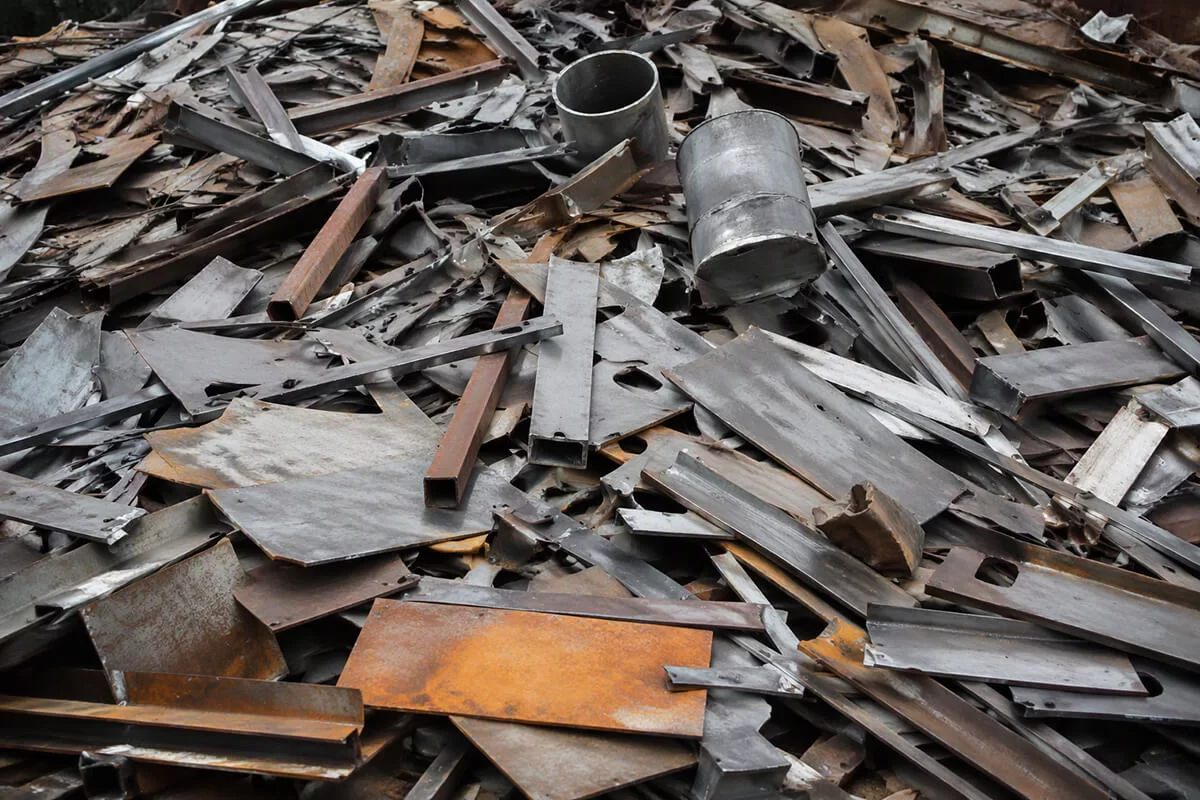
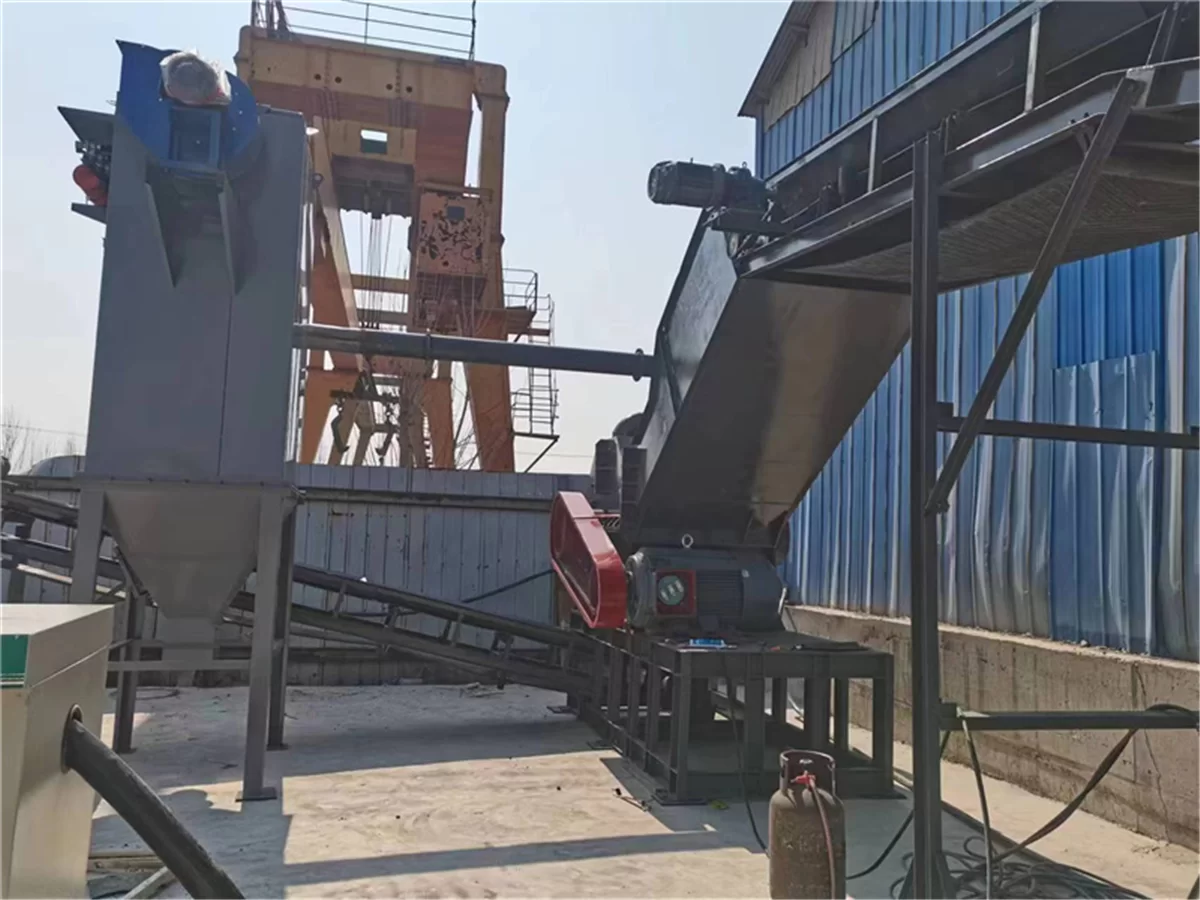
There is no single output size that is suitable for every baled scrap furnace charging project.
One furnace may accept opened scrap with irregular dimensions, while another relies on a conveyor, charging bucket or narrow feeding opening that limits the maximum piece size. The suitable output must therefore be determined from the furnace and material conditions before selecting a shredder.
A twin shaft shredder is commonly used to open compressed metal bales and perform coarse size reduction. However, the machine does not normally produce the same uniform particle size as a high-speed metal crusher equipped with a screen.
If the shredded scrap will be sent directly to a furnace, the first question should not be “How small can the shredder make it?” The better question is:
“What material size can the existing furnace charging system handle safely and continuously?”
Start with the Furnace Charging Method
The furnace charging method often determines the acceptable output size more directly than the furnace itself.
Common charging methods include:
Direct loading by grab crane
Charging bucket
Skip charging system
Vibrating feeder
Belt conveyor
Chain conveyor
Manual or semi-automatic loading
A grab crane can generally handle irregular loose scrap more easily than a narrow conveyor or enclosed charging system. A conveyor-fed furnace usually requires better control over the maximum piece length because long or folded metal can bridge at transfer points.
Before specifying an output size, the customer should provide:
Furnace charging opening dimensions
Charging bucket dimensions
Conveyor width
Transfer chute dimensions
Maximum acceptable piece length
Maximum acceptable piece weight
Required charging rate
Available space above the charging opening
These measurements help determine whether coarse shredder output can be used directly or whether secondary crushing is necessary.
What a Twin Shaft Shredder Produces
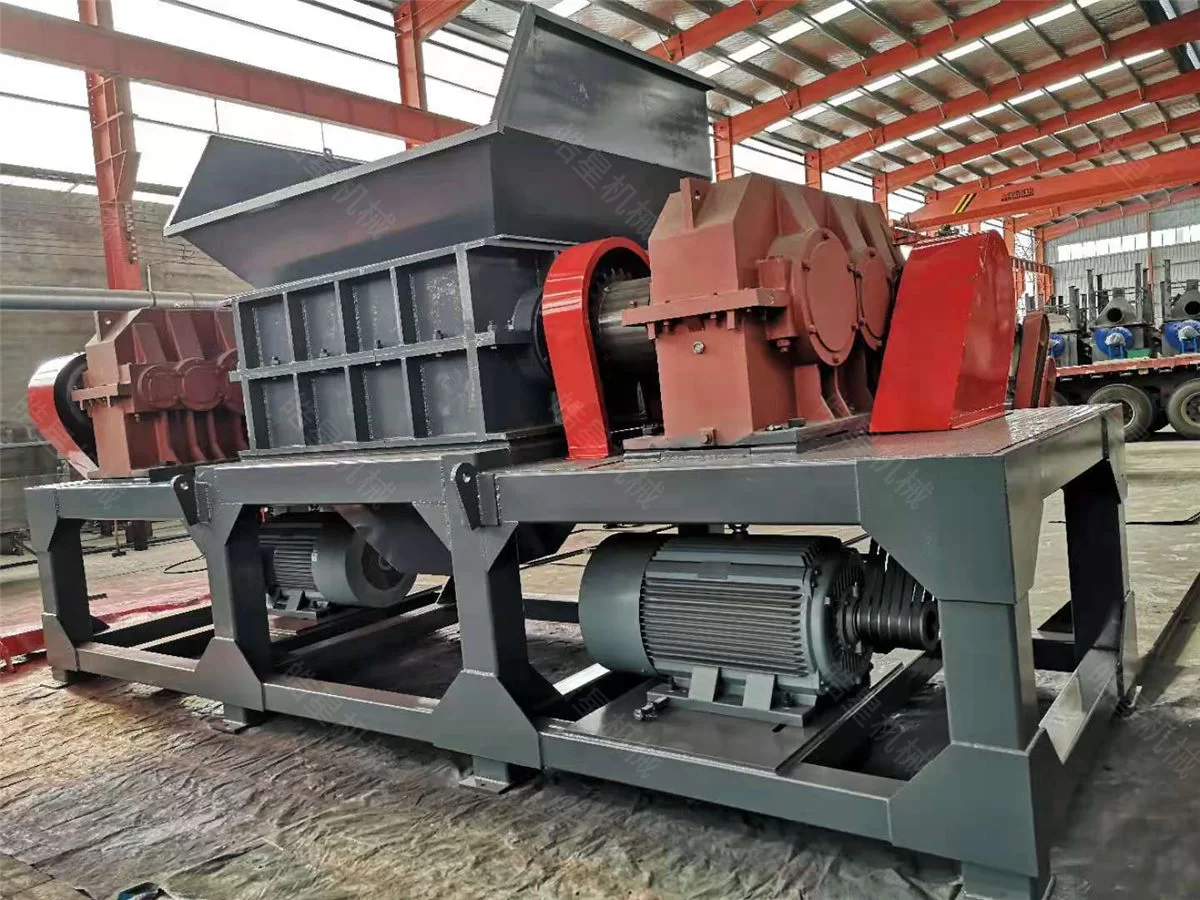
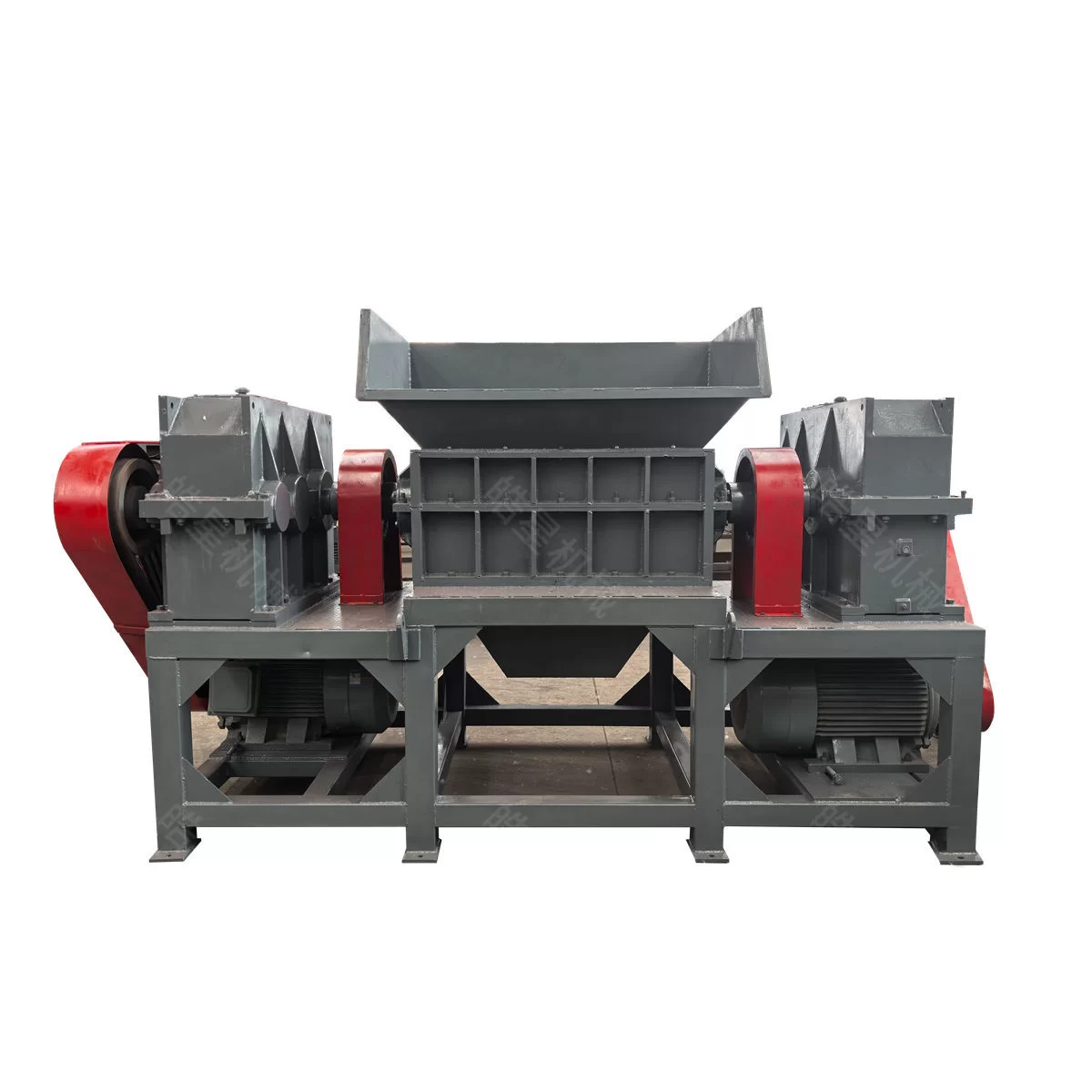
A twin shaft shredder uses two low-speed shafts fitted with intermeshing cutters. The cutters grip, tear, squeeze and shear the compressed bale until the bale opens and the material falls from the cutting chamber.
The main purpose is to:
Open compacted bales
Reduce the size of oversized material
Separate compressed layers
Produce loose scrap for handling
Prepare the material for inspection or sorting
Improve feeding into downstream equipment
The discharged material is generally coarse and irregular.
Some pieces pass between the cutters after being torn several times. Other pieces may separate from the bale and leave the chamber after fewer cutting actions. As a result, the output normally contains a range of sizes rather than one fixed dimension.
This is normal for low-speed coarse shredding.
A buyer should not assume that a stated output of 100 mm means every discharged piece will measure exactly 100 mm. The actual result depends on the material shape, blade arrangement, cutter spacing and number of cutting cycles.
Why Bale Dimensions Do Not Equal Shredder Output
A large bale does not necessarily produce large individual pieces after opening.
For example, a bale measuring 1,000 × 800 × 600 mm may contain thin steel sheets already cut into relatively small pieces. Once the outer compressed structure is opened, many pieces may separate without requiring extensive shredding.
Another bale of the same dimensions may contain folded sheets, long steel strips or appliance shell sections. After opening, some pieces may remain long or connected.
The bale dimensions only show whether the complete bale can enter the feeding hopper. They do not predict the dimensions of the individual pieces discharged from the shredder.
To estimate the output more accurately, the supplier needs to know:
Original size of the metal pieces inside the bale
Metal thickness
Presence of folded sheet
Length of strips and wires
Bale density
Type of binding material
Required cutter width
Number of cutter hooks
Clear photos of the loose material before baling are especially useful.
Cutter Width Influences the Output, but Does Not Control It Alone
Cutter width is one of the main factors affecting the output of a twin shaft shredder.
Narrower cutters create more cutting positions along the shafts. This can increase the number of shearing actions applied to the material. Wider cutters are often selected for stronger working conditions and coarse shredding.
However, cutter width should not be treated as the exact finished-product size.
The final output is also influenced by:
Cutter diameter
Hook shape
Number of hooks
Shaft spacing
Cutting chamber length
Shaft speed
Motor power
Available torque
Material thickness
Bale compression density
Automatic reversing settings
A thin steel sheet can fold between the cutters and leave the chamber with one dimension longer than the cutter width. Long strips may also remain connected after several cuts.
For this reason, cutter design should be selected around the required processing result rather than a single nominal output number.
Coarse Output May Be Suitable for Direct Furnace Charging
If the furnace accepts loose, irregular scrap, the material may not need to be reduced into small particles.
Coarse output can be acceptable when:
The bales contain known ferrous scrap.
Individual metal pieces are relatively thin.
Long wires and oversized pieces have been removed.
The charging opening is sufficiently large.
A grab crane or large charging bucket is used.
The material does not need precision sorting.
The operator accepts a range of scrap dimensions.
The opened material falls and transfers without bridging.
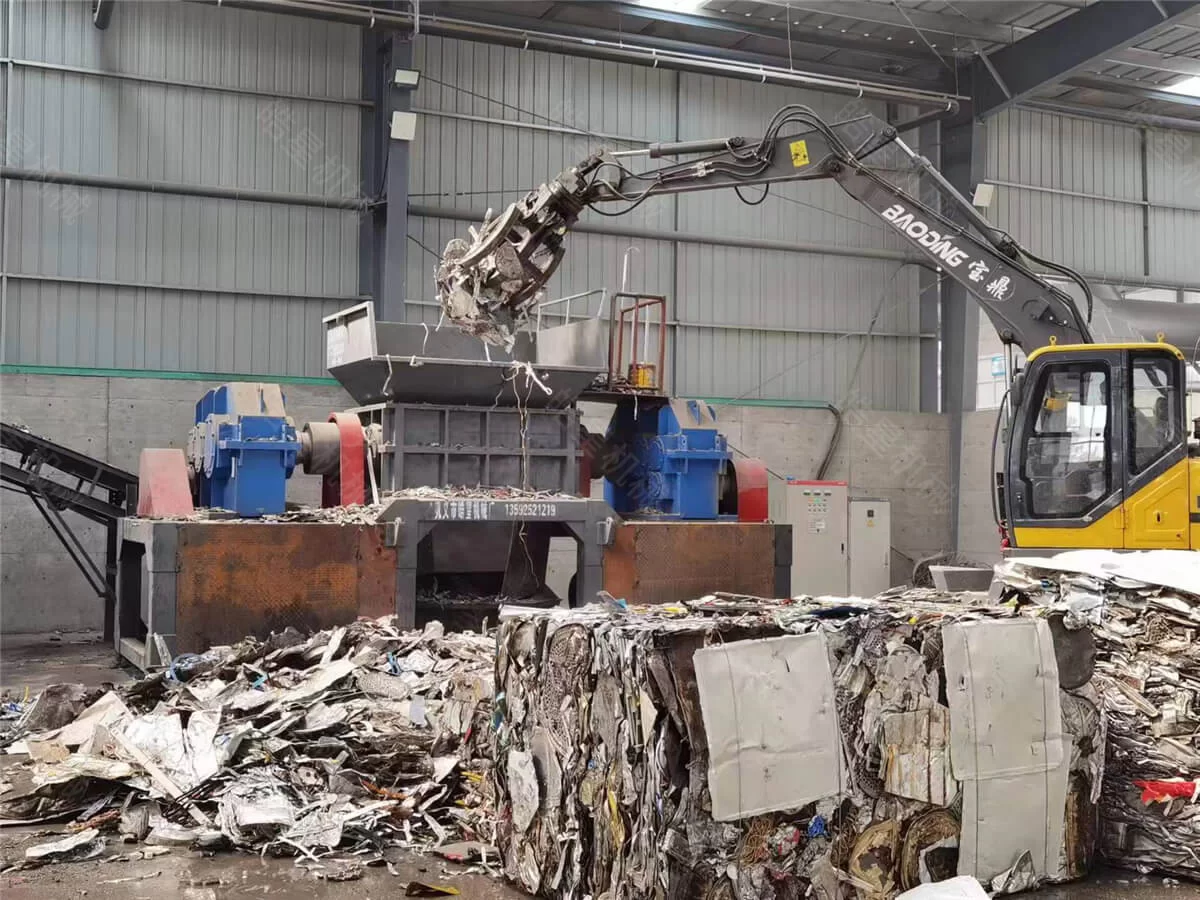
In this application, the purpose of the baled scrap shredder is primarily to open the compressed bale and make the material easier to handle.
A simple process may include:
Feeding conveyor → Twin shaft shredder → Discharge conveyor → Furnace charging
If inspection is required, a sorting platform can be installed before or after shredding. A magnetic separator can also be added when mixed material needs to be separated before melting.
When Smaller Output Is Required
Smaller output is usually required when the downstream system cannot handle irregular coarse scrap.
Typical reasons include:
A Narrow Furnace Opening
Long folded pieces may become stuck at the furnace entrance. The material must be reduced below the opening dimensions with enough clearance to avoid bridging.
Conveyor Transfer Points
A piece may fit on the main conveyor but become lodged in a transfer chute. The narrowest point in the entire conveying route should be checked.
Automatic Charging Equipment
Automated systems generally require more predictable material flow than grab crane loading. Long pieces can interfere with sensors, gates and metering equipment.
Product Storage
Large irregular scrap can leave empty spaces inside storage bins and make discharge unstable. Smaller material may flow more consistently.
Further Separation
Magnetic separators, screens and eddy current separators perform better when the material is distributed in a controlled layer. Very large pieces can cover smaller material and reduce separation efficiency.
Furnace Process Requirements
Some customers set maximum feed dimensions to improve charging consistency. The required size should be obtained directly from the furnace operator.
When these conditions apply, a secondary metal crusher may be needed after the primary shredder.
A Metal Crusher Provides Better Size Control
A metal crusher and a twin shaft shredder perform different functions.
The twin shaft shredder uses low-speed torque to open and coarsely shred the bale. The metal crusher uses high-speed hammer impact to reduce the opened material further.
A screen installed in the crusher controls which pieces can leave the crushing chamber. Material that remains too large continues to receive hammer impacts until it can pass through the screen opening.
This process provides a smaller and generally more consistent output than primary twin shaft shredding alone.
A possible line arrangement is:
Feeding conveyor → Twin shaft shredder → Metal crusher → Discharge conveyor → Magnetic separator → Furnace feed
This configuration may be suitable when:
Large folded sheets remain after primary shredding.
Maximum output size must be restricted.
The furnace uses an automatic charging system.
Improved bulk density is required.
Ferrous material must be cleaned before melting.
The customer needs more consistent furnace feed.
The crusher model and screen opening should be selected according to the actual feed material and furnace requirement.
Smaller Is Not Always Better
Reducing the output size beyond the furnace requirement can increase operating costs without adding practical value.
Additional crushing may lead to:
Higher total power consumption
Faster hammer and liner wear
More dust
More fine material
Greater maintenance requirements
Additional conveyor equipment
Increased equipment investment
Higher noise levels
More complicated electrical control
Very small or thin scrap may also be more difficult to contain during conveying and storage. Fine material can fall through conveyor gaps or be carried into the dust collection system.
The objective should therefore be to produce material small enough for reliable charging, but not unnecessarily fine.
The shortest process that meets the furnace requirement is usually the more economical choice.
Maximum Piece Size Is More Important Than Average Size
Customers often describe the desired output using an average value. For furnace charging, the maximum piece size may be more important.
A large quantity of acceptable material can still flow poorly if a few long pieces repeatedly block the conveyor or charging opening.
Before confirming the process, the following limits should be defined:
Maximum piece length
Maximum piece width
Maximum metal thickness
Maximum single-piece weight
Acceptable percentage of oversized material
Whether long flexible pieces are allowed
If the downstream system cannot accept occasional oversized pieces, the line may require:
Secondary crushing
A screen
Oversized material return
Manual inspection
A separate cutting station
A twin shaft shredder without a discharge screen cannot guarantee that every piece will remain below one precise dimension.
Material Thickness Changes the Required Shredding Effort
Output size cannot be considered without metal thickness.
Thin sheet metal may fold and pass between the cutters. A long thin piece is not necessarily difficult to melt, but the same piece may cause a feeding problem in a narrow conveyor or chute.
Thicker material requires more cutting force. Attempting to produce very small pieces from thick steel can significantly increase:
Cutter load
Motor current
Reverse frequency
Processing time
Blade wear
Shaft stress
If the bales contain mixed material thicknesses, the shredder should be selected according to the most difficult regular material, not only the average bale content.
Large solid shafts, gears, heavy castings and thick structural sections should be identified separately. These materials may require pre-sorting or a different processing method.
Check Whether the Scrap Contains Long Material
Long material creates a specific problem that is not fully described by bale weight or density.
Common examples include:
Steel wire
Cable
Narrow steel strip
Reinforcing bar
Long production offcuts
Pipes
Frame sections
These materials may wrap around the cutter shafts or remain connected to several pieces after the bale opens.
Even when the total output appears suitable, one long strip can cause bridging at the next conveyor transfer point.
Customers should provide the maximum length of these materials and an estimate of how frequently they occur. If long pieces are common, the cutter arrangement and feeding method may need to be adjusted.
Pre-sorting can also be used to remove unsuitable long material before shredding.
Magnetic Separation May Be Needed Before Furnace Charging
If the bale contains mixed ferrous and non-ferrous material, opening the bale does not automatically make the entire output suitable for a steel furnace.
A magnetic separator can recover magnetic ferrous material after shredding. The separation result depends on the extent to which the materials have been released from each other.
A possible process is:
Feeding conveyor → Twin shaft shredder → Magnetic separator → Ferrous scrap discharge → Furnace charging
This arrangement is useful when coarse ferrous recovery is sufficient and small, uniform output is not required.
However, overlapping or connected materials may reduce separation efficiency. A piece of aluminum trapped inside folded steel can follow the ferrous discharge. Rubber or plastic attached to steel may also remain in the recovered product.
If higher material purity is required, additional crushing and sorting should be evaluated.
Do Not Ignore Expanded Material Volume
A compressed bale occupies much less space than its opened material.
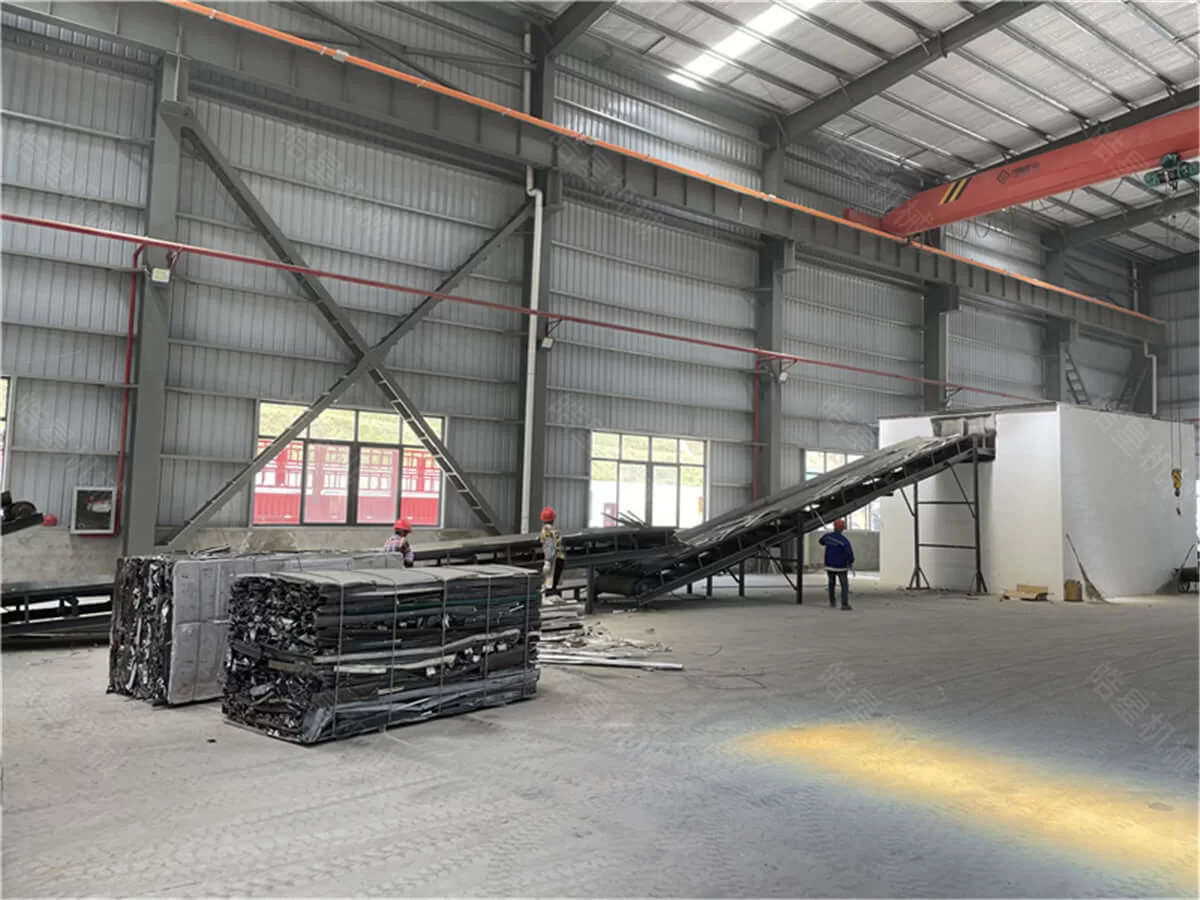
After shredding, the scrap becomes loose and its apparent volume can increase considerably. The discharge conveyor must carry this expanded material without allowing it to accumulate below the shredder.
When selecting the conveyor, consider:
Maximum discharged piece size
Expanded material volume
Conveyor width
Sidewall height
Conveyor speed
Inclination angle
Transfer height
Furnace feeding rate
A conveyor selected only according to tons per hour may be too narrow for light, bulky output.
Stable furnace charging requires both sufficient weight capacity and sufficient volume capacity.
Information Needed to Confirm the Output Requirement
Before selecting a baled scrap shredder for furnace charging, the customer should provide:
Photos and videos of the complete bales.
Photos of the loose material before baling, if available.
Maximum and typical bale dimensions.
Average and maximum bale weight.
Main metal type and approximate composition.
Maximum material thickness.
Length of wires, strips and other long pieces.
Maximum size and weight of solid objects.
Furnace type.
Furnace charging opening dimensions.
Charging method.
Charging conveyor or bucket dimensions.
Maximum acceptable feed size.
Maximum acceptable piece weight.
Required hourly charging capacity.
Whether magnetic separation is required.
Whether mixed output sizes are acceptable.
Whether fine material is acceptable.
Daily operating hours.
Local power supply.
If the customer cannot define the required output size, the dimensions of the narrowest charging point should be provided for evaluation.
A representative material test can then be used to check whether primary shredding produces suitable furnace feed.
Select the Output Around the Charging System
The correct output size for baled scrap furnace charging depends on the complete material route, not only on the shredder.
If the furnace uses a large opening and grab crane charging, coarse material from a twin shaft shredder may be acceptable. If the scrap passes through narrow conveyors, chutes or automatic charging equipment, smaller and more consistent output may be necessary.
A metal crusher should only be added when the primary shredder output does not meet the furnace feeding or separation requirements.
Gongyi Haoxing Machinery Factory manufactures twin shaft shredders, metal crushers and complete baled scrap processing systems in China. The production line can be equipped with feeding conveyors, discharge conveyors, magnetic separators, vibrating screens, dust collection and electrical control systems according to the actual scrap and furnace charging method.
Send us your bale photos, dimensions, weight, metal thickness, required capacity and furnace charging opening size. We will evaluate the material and recommend a suitable output range and equipment configuration.
WhatsApp: +86 186 2491 0209
Website: www.hxjx08.com