
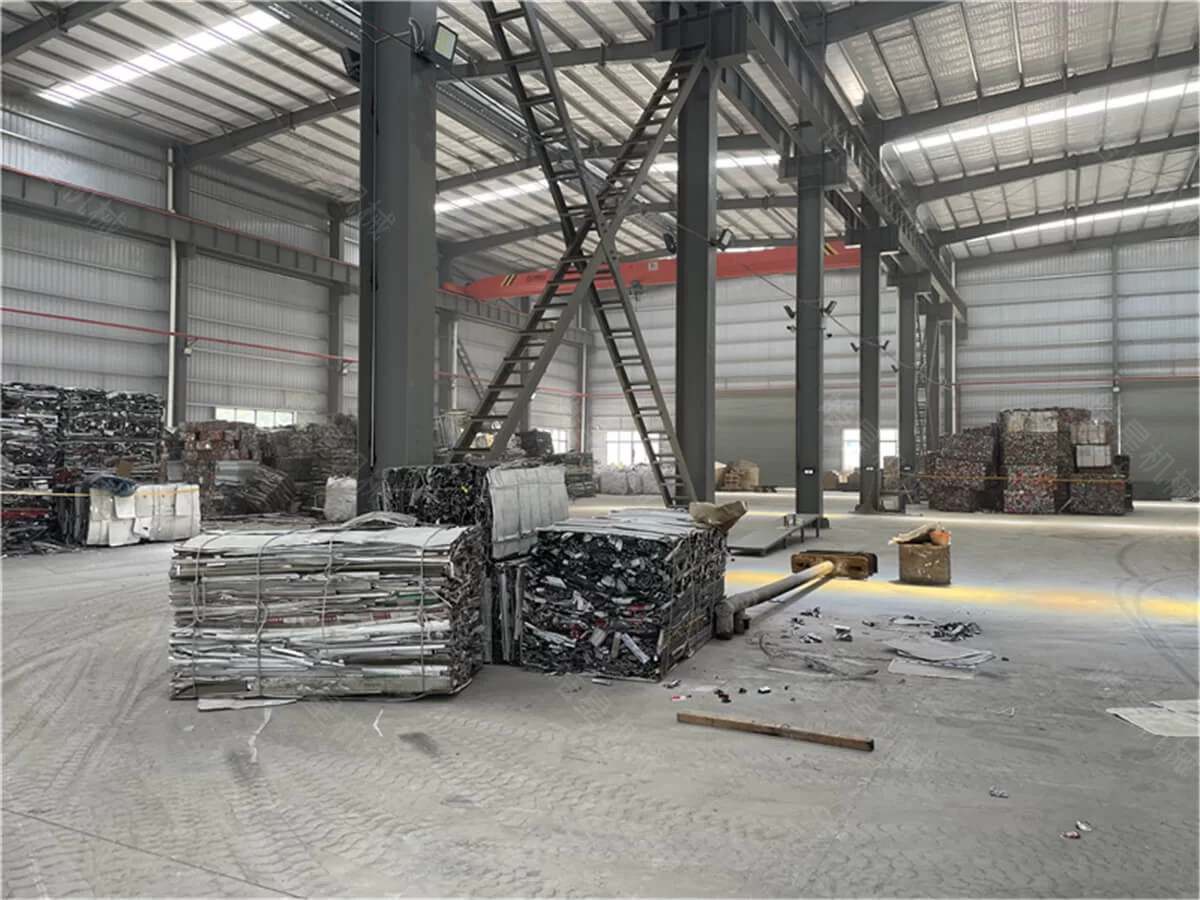
Compressed steel scrap bales save transport and storage space, but they do not always provide suitable feed for a high-speed metal crusher. A dense bale can contain folded sheet metal, long strips, wires and overlapping pieces pressed into one compact block.
When the bale dimensions, density or internal structure exceed the crusher’s stable feeding range, the complete bale should not simply be forced into the crushing chamber. A twin shaft shredder can be installed as a pre-shredding stage to open the compressed structure and convert the bale into a more controllable material flow.
The shredder is not used as a substitute for the crusher. It prepares the feed, while the crusher completes the secondary size-reduction stage.
Can Compressed Scrap Bales Go Directly into a Metal Crusher?
Some small and loosely compressed bales may be suitable for direct crushing. This depends on whether the bale dimensions, material thickness and feeding behavior match the design of the crusher.
Dense or oversized bales create a different operating condition. Instead of entering as separate pieces, the material reaches the crusher as one concentrated mass. This can result in an uneven feed and rapid changes in the load on the crushing rotor.
Potential problems include:
The complete bale may not enter the feed opening smoothly.
Folded sheet metal can bridge across the feeding area.
Long strips and wires may remain tightly entangled.
The crusher may alternate between insufficient feed and sudden overloading.
Hidden containers or unsuitable solid pieces may reach the crusher without inspection.
The compressed bale may open suddenly after entering the feeding system.
Production can become dependent on repeated manual adjustment.
These problems are not determined by bale size alone. Two bales with similar external dimensions can behave differently if their weights, compression densities and internal materials are different.
For this reason, the decision to crush directly or add pre-shredding should be based on the actual condition of the baled scrap metal.
What Pre-Shredding Changes
A compressed bale behaves as a single block. The main purpose of pre-shredding is to change that physical condition before high-speed crushing begins.
The two cutter shafts of the shredder grip the exposed edges of the bale and pull the compressed material into the cutting chamber. As the shafts rotate, the cutters tear through folded and interlocked sections gradually.
The process changes the feed in several ways:
One compact bale becomes multiple coarse pieces.
Compressed layers are released.
Long and folded sections become easier to convey.
Hidden parts of the bale become visible.
The material can be supplied to the crusher more gradually.
The downstream feeding rate becomes easier to control.
The discharge from the shredder remains coarse and irregular. This is expected because a primary shredder normally does not use a screen to produce a precise final size.
Its job is to improve the material condition, not to create the finished product.
How Pre-Shredding Improves Crusher Feeding
A high-speed metal crusher performs more consistently when it receives a controlled flow of loose material rather than complete compressed blocks.
After pre-shredding, the opened scrap can be placed on an intermediate conveyor. The conveyor acts as a buffer between the two machines and regulates how much material reaches the crusher.
This arrangement helps reduce abrupt changes in the feed condition. The crusher receives smaller portions over time instead of processing the entire mass of one bale at once.
The main operational benefits include:
More controllable material flow
The intermediate conveyor can increase, reduce or pause feeding according to the working condition of the crusher. This gives the control system more flexibility than direct bale feeding.
Fewer concentrated loads
Opening the bale distributes its weight across several pieces. This does not remove the load created by the material, but it reduces the chance of the whole bale entering as one concentrated mass.
Easier material inspection
Once the bale has been opened, operators can more easily identify sealed containers, unusually thick pieces, long wires or foreign materials that should not enter the high-speed crusher.
Better coordination between machines
The shredder can continue processing the next bale while the intermediate conveyor controls delivery to the crusher. The actual operating sequence depends on the capacity balance between the two machines.
More stable use of the crusher inlet
Loose scrap is generally easier to distribute across the feeding width. This helps avoid feeding all material into one side or one point of the crushing system.
Pre-shredding does not guarantee a specific increase in output. Its practical value is that it creates a more predictable feed condition for the secondary crushing stage.
Twin Shaft Shredder and Metal Crusher Perform Different Tasks
The two machines should not be treated as alternative names for the same equipment.
Twin Shaft Shredder
A twin shaft shredder operates at low speed and uses high torque to pull, shear and tear compressed material.
Its main functions are:
Opening compressed scrap bales
Tearing apart interlocked metal
Reducing oversized sections
Preparing material for inspection
Producing a controllable feed for downstream equipment
The output is normally coarse and irregular because the machine is intended for primary treatment.
Metal Crusher
A metal crusher operates at high speed and uses hammering or impact force to break the opened scrap further.
Its main functions are:
Secondary size reduction
Breaking sheet metal into smaller pieces
Releasing attached materials
Increasing the uniformity of the processed scrap
Producing an output controlled by the installed screen
The crusher is used when the project requires a smaller and more consistent finished material.
Process Comparison
Twin Shaft Shredder
Operating principle: Low-speed cutting and tearing
Primary purpose: Bale opening and coarse pre-shredding
Feed condition: Compressed bales and large interlocked scrap
Discharge condition: Coarse and irregular pieces
Screen-controlled size: Usually no
Position in the process: Before the crusher
Metal Crusher
Operating principle: High-speed hammering or impact
Primary purpose: Secondary crushing
Feed condition: Opened and controllably fed scrap
Discharge condition: Smaller processed metal
Screen-controlled size: Yes
Position in the process: After pre-shredding when finer output is required
Using both machines does not mean that they duplicate each other. Each machine solves a different production problem.
Which Scrap Bales Are More Likely to Require Pre-Shredding?
Pre-shredding should be considered when one or more of the following conditions apply:
The bale is larger than the crusher’s stable feed range.
The bale has a high compression density.
Thin sheets are folded and tightly interlocked.
The material contains long strips or wire.
Complete bales cause large fluctuations in crusher load.
The internal composition of purchased bales is uncertain.
Material inspection is required before high-speed crushing.
Manual opening takes too much time.
The production line requires continuous and controlled feeding.
The crusher cannot grip complete bales consistently.
A pre-shredder may not be required when the bales are small, loosely compressed and proven to feed safely into the selected crusher.
The correct decision should be based on the actual material, not only on the general name “steel scrap bale.”
What Should Be Checked Before Adding a Pre-Shredder?
The following factors have the greatest influence on whether primary shredding is necessary:
Bale dimensions
The length, width and height of the bale must be compared with the shredder chamber and the crusher feeding system.
Bale weight and density
A compact bale may create a much higher instantaneous load than a loosely compressed bale of the same size.
Scrap thickness
Thin sheet metal behaves differently from thick plate, cast steel or solid sections. A shredder selected for light scrap should not be assumed suitable for heavy solid material.
Internal composition
Wires, long strips, sealed containers and non-metal attachments can influence the opening process and may require inspection before secondary crushing.
Required final size
If the customer only needs to open and loosen the bales, a standalone shredder may be enough. If a smaller, screen-controlled product is required, a metal crusher should be added downstream.
Capacity balance
The shredder, conveyors and crusher must have compatible processing capacities. Installing a large shredder in front of a smaller crusher does not increase the capacity of the complete line.
Recommended Processing Route
A typical two-stage process can be arranged as follows:
Compressed Scrap Bale → Twin Shaft Pre-Shredding → Material Inspection → Controlled Conveyor Feeding → Metal Crushing → Screening or Separation
Each stage has a clear purpose.
Compressed Scrap Bale
The incoming material is stored and transported in a compact form.
Twin Shaft Pre-Shredding
The compressed structure is opened and large interlocked sections are reduced.
Material Inspection
Visible containers, oversized solid pieces and unsuitable foreign materials can be removed before high-speed crushing.
Controlled Conveyor Feeding
The opened scrap is delivered to the crusher at a rate that matches its operating condition.
Metal Crushing
The crusher uses high-speed impact to reduce the material further.
Screening or Separation
The processed output can be screened or separated according to the required recycling process.
This route is not mandatory for every project. It is intended for materials that cannot be supplied to the crusher safely and consistently in their original baled condition.
When a Standalone Baled Scrap Shredder Is Enough
Not every project requires secondary crushing.
A standalone baled scrap shredder may be sufficient when the customer needs to:
Open compressed bales
Reduce manual dismantling
Loosen material for sorting
Prepare scrap for furnace charging
Improve conveyor handling
Inspect the contents of purchased bales
Feed an existing downstream system
In these applications, the coarse discharge is the required processing result rather than an intermediate product.
Adding a crusher would only be justified if the customer needs smaller pieces, screen-controlled output or additional material liberation.
When a Complete Baled Scrap Shredding Plant Is More Suitable
A complete baled scrap shredding plant becomes more appropriate when the project requires several coordinated stages.
Depending on the actual processing objective, the plant may include:
Bale feeding
Primary shredding
Intermediate material inspection
Controlled crusher feeding
Secondary crushing
Screening
Magnetic separation
Dust collection
The plant should not be configured by adding every available machine. Each section must solve a specific processing requirement.
For example, a magnetic separator is relevant when ferrous metal must be recovered from a mixed material stream. A vibrating screen is relevant when the output needs to be divided by size. Neither machine should be included only to make the production line appear more complete.
Final Assessment
A twin shaft shredder opens compressed steel scrap bales before crushing by tearing apart the dense structure and converting the bale into a loose, controllable material flow.
The benefit is not simply that the scrap becomes smaller. The more important change is that the crusher no longer receives the material as one unpredictable compressed block.
The shredder prepares the feed. The intermediate conveyor controls the delivery rate. The crusher then performs high-speed secondary size reduction and uses its screen to control the final output.
Pre-shredding should be used when the bale dimensions, compression density, material composition or feeding behavior make direct crushing unstable or unsuitable. Small and loosely compressed bales may not require this stage, so the final configuration should always be based on actual material conditions.