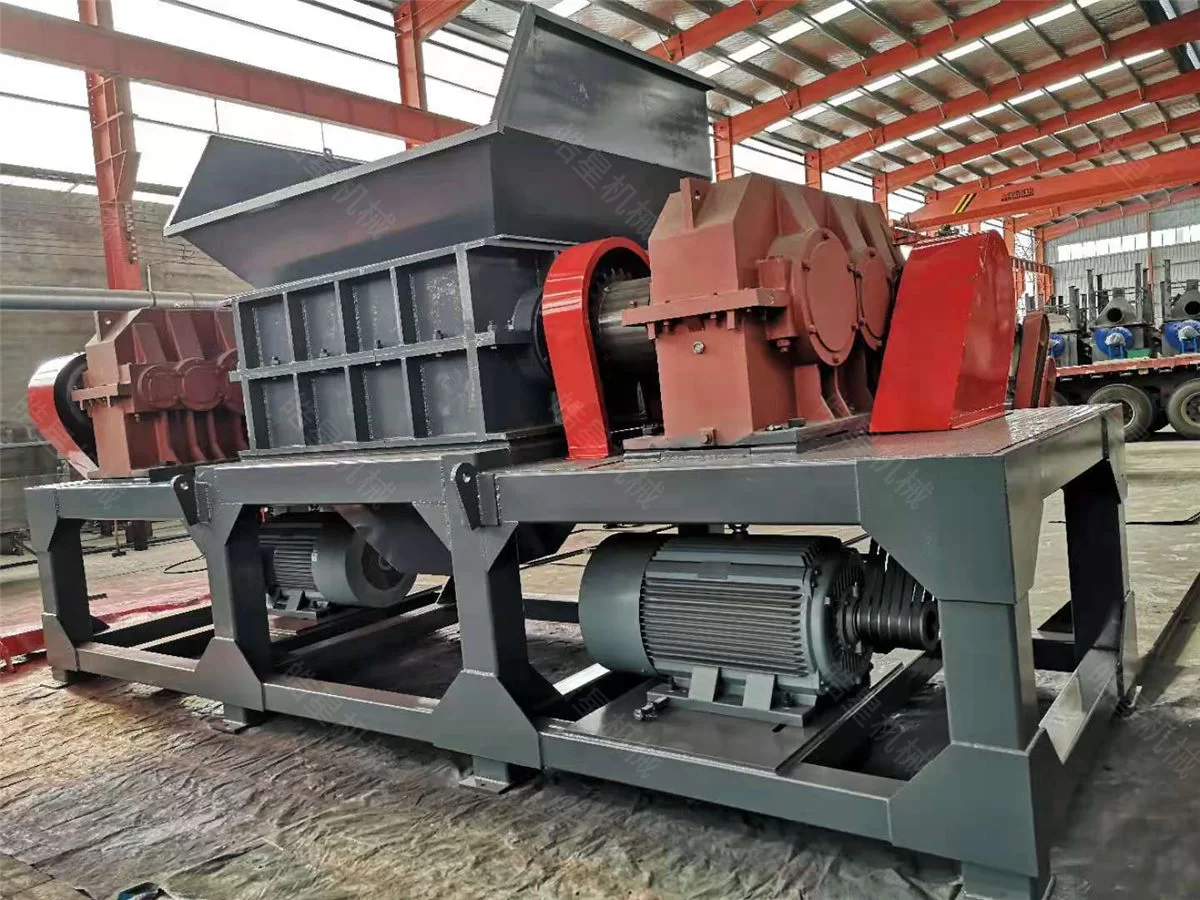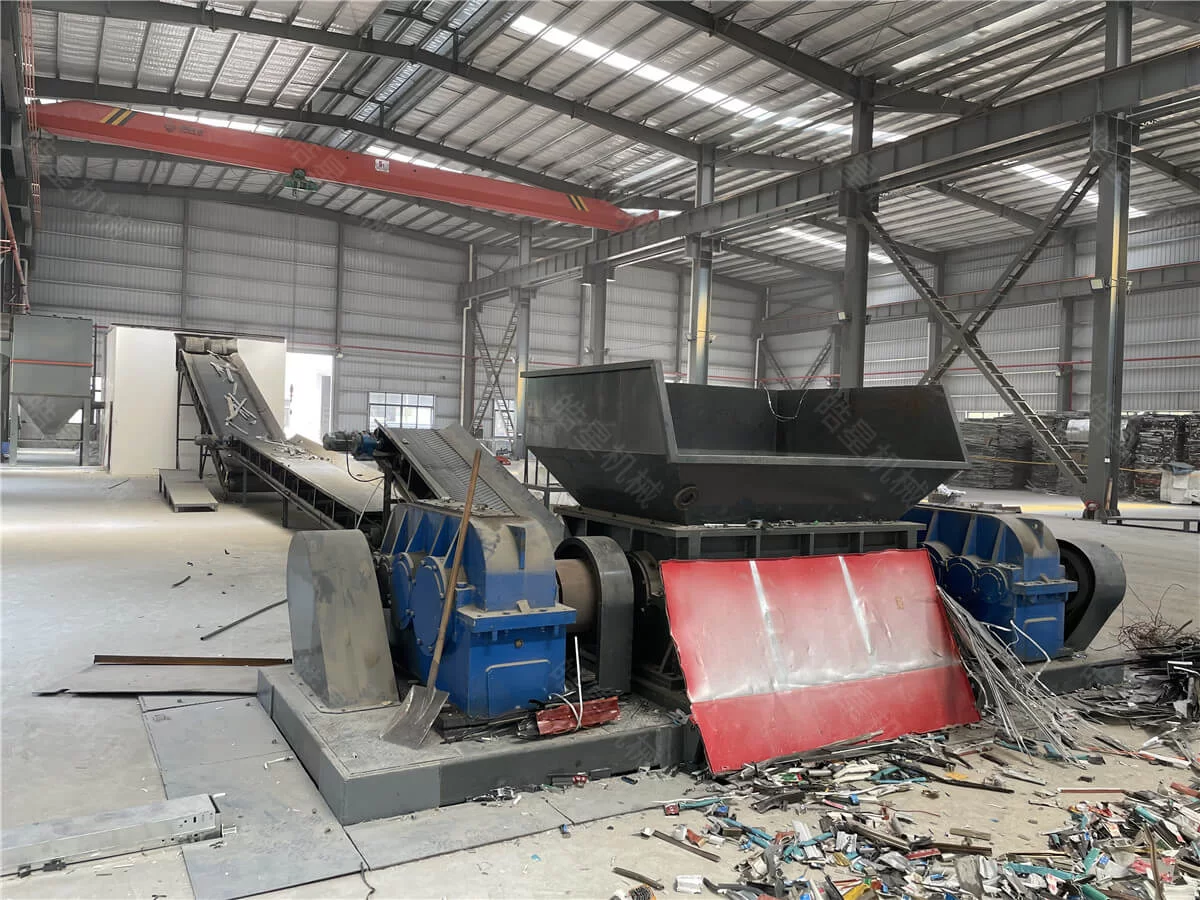
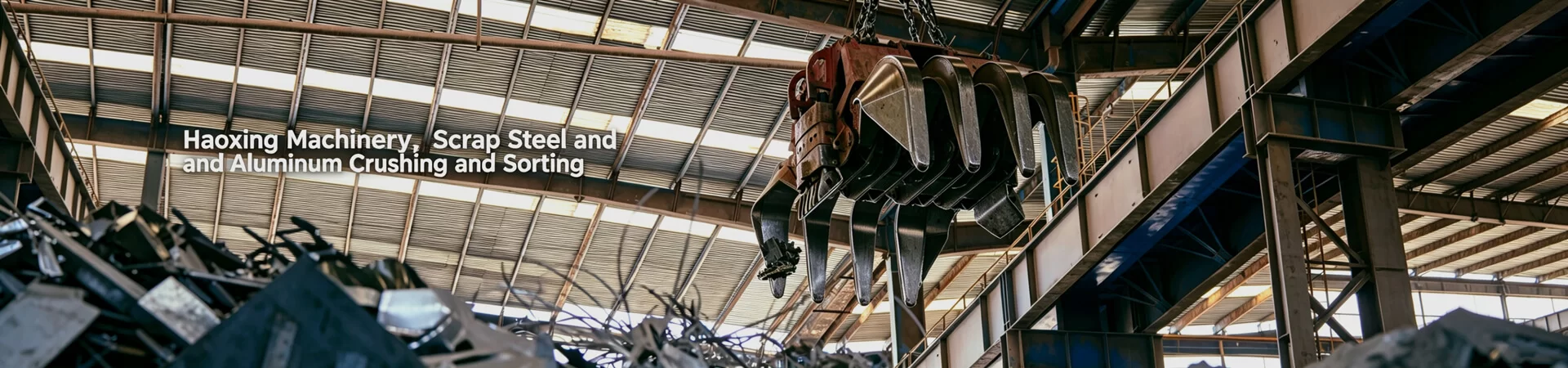
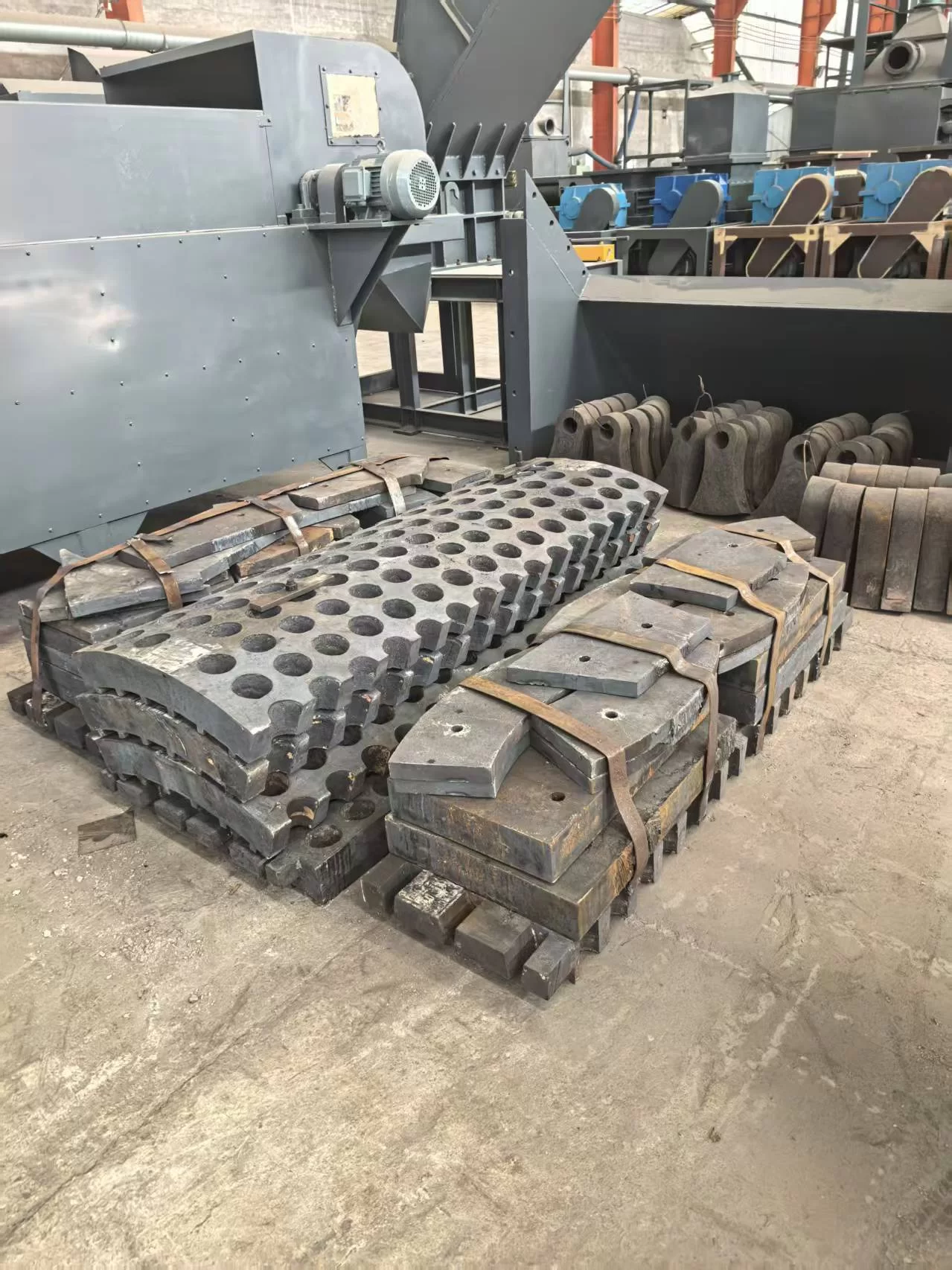
A shredder described as producing five tons per hour will not necessarily process every type of metal bale at that rate.
A loosely compressed bale of aluminum cans may open quickly, while a dense bale containing folded steel sheets, long strips and solid metal parts may cause repeated reversing. Both bales may weigh 500 kg, but the time needed to process them can be very different.
This is why baled scrap shredder capacity should be estimated from the customer’s actual material rather than from motor power or machine size alone.
Before choosing a shredder, buyers should provide the bale weight, dimensions, material composition, metal thickness and required discharge condition. These details allow the equipment manufacturer to estimate a practical production range and select a suitable feeding system.
Start with Bale Weight and Processing Time
A simple way to estimate hourly input is to calculate how many bales can be processed in one hour.
The basic formula is:
Hourly input = Average bale weight × Number of bales processed per hour
For example, if each bale weighs 500 kg and the shredder processes eight bales per hour:
500 kg × 8 bales = 4,000 kg/h
The theoretical input is therefore 4 tons per hour.
This calculation is useful, but it does not yet represent stable production over a complete working shift. It assumes that every bale has a similar composition and that feeding continues without interruption.
In actual operation, time is also required for:
Loading bales onto the feeding conveyor
Waiting for the previous bale to open
Automatic reversing under high load
Removing unsuitable material
Clearing material around the hopper
Inspecting cutters and shafts
Stopping downstream equipment
Routine cleaning and maintenance
A production estimate should therefore include the complete operating cycle, not only the time during which the cutter shafts are rotating.
Bale Dimensions Do Not Determine Capacity by Themselves
Bale dimensions are important because the complete bale must enter the feeding hopper and reach the cutting chamber. However, outside dimensions do not show how much metal is compressed inside the bale.
Consider two bales with the same dimensions:
Bale A measures 1,000 × 800 × 600 mm and weighs 300 kg.
Bale B measures 1,000 × 800 × 600 mm and weighs 600 kg.
Although both bales fit through the same feeding opening, Bale B contains twice as much material in the same volume.
Bale B may require more torque and a longer processing time. If the individual metal pieces are also thicker, the difference in processing time may be even greater.
When checking bale dimensions, the buyer should provide:
Maximum bale length, width and height
Common bale dimensions
Average bale weight
Maximum bale weight
Whether the bale expands after its straps are removed
Type and number of binding wires or straps
The feeding opening should be selected with enough clearance for irregular bales. A bale that is nominally 800 mm wide may have protruding corners or bent metal pieces that increase the actual feeding width.
Bale Density Changes the Number of Bales Processed Per Hour
Bale density can be estimated by dividing bale weight by bale volume.
Bale density = Bale weight ÷ Bale volume
A higher density means more material has been compressed into the same space. This usually gives the cutters less room to enter between the individual pieces.
Low-density bales commonly open in stages. Once the cutters tear the outer layers, the remaining material becomes loose and falls into the cutting chamber.
Dense bales may behave differently. The bale can remain compact after entering the hopper, requiring the cutter shafts to grip it several times before the compressed structure begins to separate.
During this process, the control system may stop the feeding conveyor or reverse the cutter shafts to reduce the load. These protective actions are necessary, but they also increase the processing time per bale.
If a low-density bale takes four minutes to process, the theoretical rate is 15 bales per hour. If a dense bale of the same outside dimensions takes eight minutes, the theoretical rate falls to 7.5 bales per hour.
The weight of each bale may be higher, so the hourly tonnage does not necessarily fall by the same percentage. The actual result depends on the balance between bale weight and processing time.
Material Composition May Matter More Than Bale Weight
Two 500 kg bales do not always place the same load on a twin shaft shredder.
A bale containing thin beverage cans can be easier to open than a bale containing steel sheets, reinforcing bars and solid machine parts. Bale weight is therefore only one part of the capacity calculation.
The following material characteristics should be checked before estimating output.
Metal thickness
Thin sheet metal normally bends and tears more easily than thick plate.
If a bale contains a small number of heavy steel sections or thick offcuts, these pieces may trigger automatic reversing even when most of the material is light scrap.
The maximum thickness is usually more useful for equipment selection than the average thickness.
Long metal pieces
Long strips, wire, cable and reinforcing bar can remain connected after the surrounding material has been opened.
These materials may wrap around the shafts or prevent loose scrap from falling from the cutting chamber. The resulting output may be lower than the estimate based only on bale weight.
Solid metal objects
Shafts, gears, castings and heavy mechanical parts behave differently from compressed sheets and cans.
Large solid pieces should be identified during pre-sorting. A baled scrap shredder intended for coarse opening of light scrap should not automatically be expected to process every solid object found inside a mixed bale.
Non-metallic materials
Rubber, plastic, fabric, foam and other attachments change how the bale opens. Flexible materials may stretch between the cutters instead of separating immediately.
Non-metallic materials also affect the apparent bale volume and can create an uneven flow on the discharge conveyor.
Feeding Time Must Be Included in the Calculation
The shredder cannot maintain its rated output if the next bale is not available when the cutting chamber is ready.
Bales may be loaded using:
A forklift
A grab crane
A hydraulic loader
A chain plate conveyor
A manual feeding platform
Each feeding method has a different loading cycle.
A forklift may need to collect a bale from the storage area, turn, approach the hopper and position the bale. A grab crane may feed more continuously, but the operator must still avoid placing a second dense bale above material that has not yet been opened.
For a realistic capacity estimate, record the total time from the start of one bale to the start of the next bale.
For example:
Shredding time per bale: 5 minutes
Loading and positioning time: 1 minute
Average reversing and waiting time: 1 minute
Total cycle time: 7 minutes
The number of complete cycles per hour is:
60 ÷ 7 = approximately 8.6 bales per hour
If the average bale weighs 500 kg:
8.6 × 500 kg = approximately 4.3 tons per hour
This estimate is more realistic than calculating capacity from shredding time alone.
Rated Capacity and Average Capacity Are Different
When a supplier states a capacity range, the buyer should ask what the figure represents.
Capacity may refer to:
Maximum short-term input
Nominal input under suitable conditions
Average input over one working hour
Average production over one complete shift
Minimum guaranteed continuous output
Weight of the final qualified product
These figures should not be treated as equal.
A machine may briefly process five tons in one hour when handling prepared bales of similar density. However, the average over an eight-hour shift may be lower after feeding delays, reversing, inspection and cleaning are included.
For project planning, average shift capacity is generally more useful than a short-term maximum.
If the customer requires a minimum continuous output, the equipment configuration must include enough reserve capacity to handle changes in bale density and composition.
Motor Power Alone Cannot Predict Output
A higher motor power can provide more driving capacity, but it does not automatically guarantee a proportional increase in production.
Shredder performance also depends on:
Cutter diameter
Blade width
Cutter hook design
Cutter shaft speed
Gear reduction ratio
Available shaft torque
Cutting chamber dimensions
Automatic reversing settings
Feeding conveyor control
Discharge conveyor capacity
A machine with a larger motor can still produce unstable output if dense bales cannot enter the cutting chamber smoothly.
Likewise, increasing the shaft speed may not solve the problem. Low-speed, high-torque shredding relies on controlled gripping and tearing. Excessive speed can make it harder for irregular bales to settle between the cutters.
The complete mechanical and control configuration should match the actual material.
Automatic Reversing Affects Hourly Throughput
Automatic reversing protects the cutters, shafts, motors and reducers when the working load becomes too high.
When the motor current reaches the preset limit, the control system may:
Stop forward rotation.
Reverse the cutter shafts.
Release or reposition the material.
Resume forward shredding.
This process helps the machine handle difficult material without requiring the operator to stop the line manually.
However, frequent reverse cycles reduce productive cutting time.
If a shredder reverses occasionally when processing a difficult piece, the effect on hourly production may be limited. If almost every dense bale causes repeated reversing, the average output will be noticeably lower.
When reviewing a material test, buyers should not only check whether the shredder can process the bale. Buyers should also observe:
How long the bale takes to open
How many reverse cycles occur
Whether the bale rotates without entering
Whether material bridges in the hopper
Whether long pieces wrap around the shafts
Whether discharge remains continuous
A successful test means the machine processes the material at a practical and repeatable rate, not merely that the bale eventually passes through.
The Discharge Conveyor Can Limit Shredder Capacity
Compressed bales occupy relatively little space before shredding. Once opened, the loose scrap may expand to several times its original volume.
The weight does not change, but the volume on the discharge conveyor increases considerably.
If the conveyor is too narrow, too slow or has low sidewalls, opened scrap can accumulate below the shredder. This restricts discharge from the cutting chamber and eventually reduces the whole line’s output.
The discharge system should be selected according to:
Expanded material volume
Largest discharged piece
Required conveyor angle
Downstream equipment height
Material sharpness
Desired layer thickness
Required magnetic separation performance
A suitable discharge conveyor keeps the lower part of the shredder clear and provides a controlled flow to the next processing stage.
Downstream Machines Must Match the Shredder
The stated capacity of a baled scrap processing line should be based on its slowest stage.
A twin shaft shredder may open bales faster than the magnetic separator, metal crusher or screen can process the discharged material. In this case, increasing the shredder feeding rate only causes material accumulation between machines.
A complete line may include:
Feeding conveyor → Twin shaft shredder → Discharge conveyor → Magnetic separator → Metal crusher → Vibrating screen → Eddy current separator
Not every project requires all these machines.
If the customer only needs to open compressed bales before furnace charging, the twin shaft shredder and conveyors may be sufficient.
If the customer requires smaller and more consistent material for sorting, a metal crusher may be installed after primary shredding. Screening and separation equipment can then classify the material into the required fractions.
Each downstream machine should be selected according to the expected output volume and particle condition from the previous stage.
A Practical Method for Estimating Capacity
The following process provides a more reliable initial estimate.
Step 1: Record representative bale data
Measure at least several bales rather than one unusually light or heavy bale.
Record:
Dimensions
Weight
Material type
Maximum thickness
Binding method
Visible heavy objects
Step 2: Calculate the approximate density
Divide each bale’s weight by its volume. Use the results to identify how much the bales vary.
A wide density range usually indicates that hourly output will also vary.
Step 3: Estimate the complete bale cycle
Include:
Bale loading
Positioning
Active shredding
Automatic reversing
Waiting for discharge
Preparation for the next bale
Step 4: Calculate theoretical hourly input
Multiply average bale weight by the number of full cycles completed per hour.
Step 5: Apply an operating allowance
Do not plan a full shift on the assumption that the machine will run continuously without interruption.
The allowance should reflect material variation, operator experience, pre-sorting and maintenance requirements.
Step 6: Check the downstream capacity
Confirm that every conveyor, separator, crusher and screen can accept the estimated flow.
The final production line capacity should be based on the complete process, not only on the primary shredder.
Information Needed Before a Supplier Confirms Capacity
Customers requesting a baled scrap shredder quotation should provide the following information:
Clear photos of complete bales
Close-up photos showing the material
Short videos of the bales being handled
Maximum and common bale dimensions
Average and maximum bale weight
Main metal types and approximate percentages
Maximum metal thickness
Maximum size and weight of solid pieces
Presence of wire, cable or long strips
Percentage of plastic, rubber and other impurities
Required hourly input
Daily operating hours
Required discharge size
Purpose of the shredded material
Downstream crushing or sorting requirements
Local power supply
When possible, a test using the customer’s actual bales provides a better basis for capacity estimation than a test using a different type of scrap.
Capacity Should Be Based on the Actual Material
Baled scrap shredder capacity cannot be determined from motor power or bale dimensions alone.
Bale weight, density, material thickness, internal composition, feeding time, automatic reversing and discharge capacity all affect the number of tons that can be processed during continuous operation.
A reliable estimate starts with representative bale information. It then considers the full feeding and shredding cycle, as well as the capacity of every downstream machine.
Gongyi Haoxing Machinery Factory manufactures twin shaft shredders and complete baled scrap processing lines in China. Feeding conveyors, magnetic separators, metal crushers, vibrating screens, eddy current separators, dust collection and electrical control systems can be configured according to the material and required final output.
Send us your bale dimensions, average weight, material photos, required capacity and final product requirements. We will evaluate the actual operating conditions and recommend a suitable equipment configuration.
WhatsApp: +86 186 2491 0209
Website: www.hxjx08.com