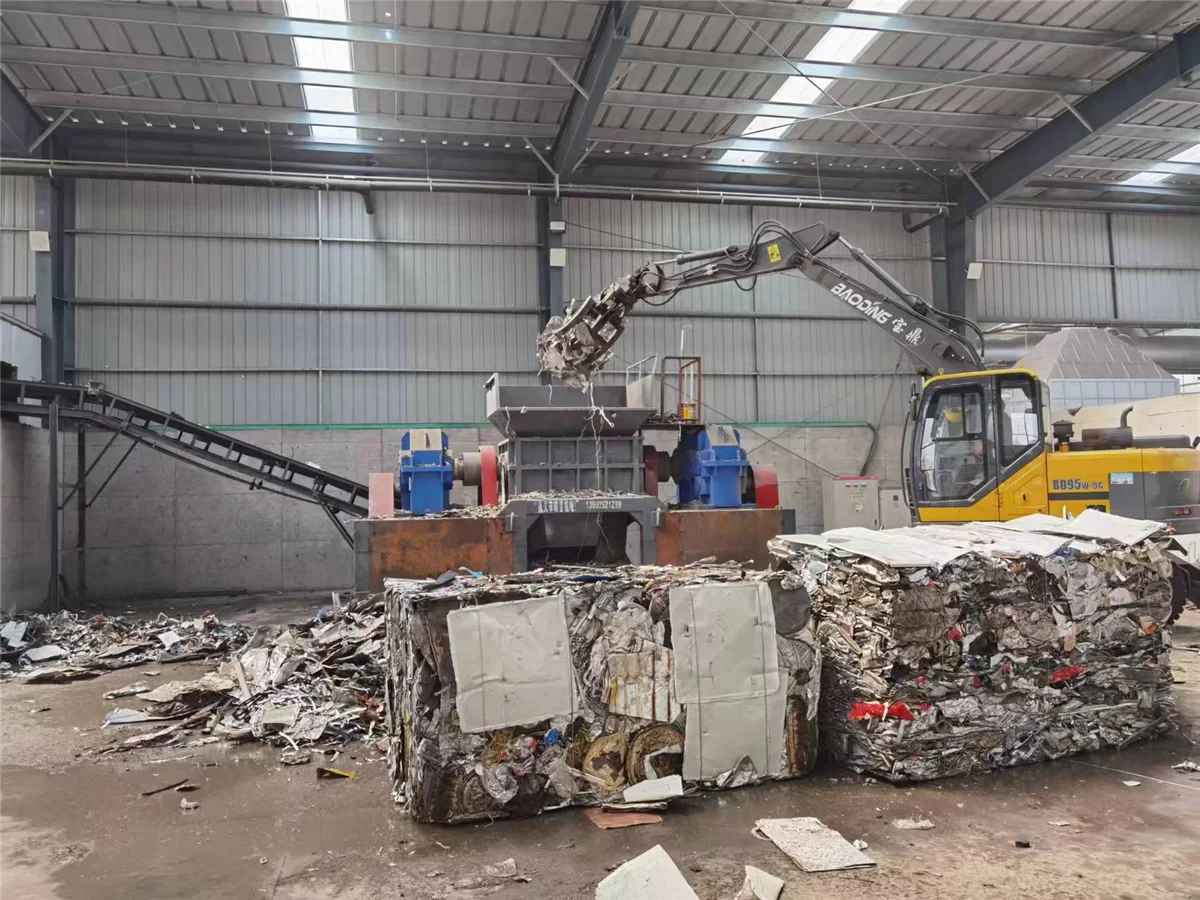
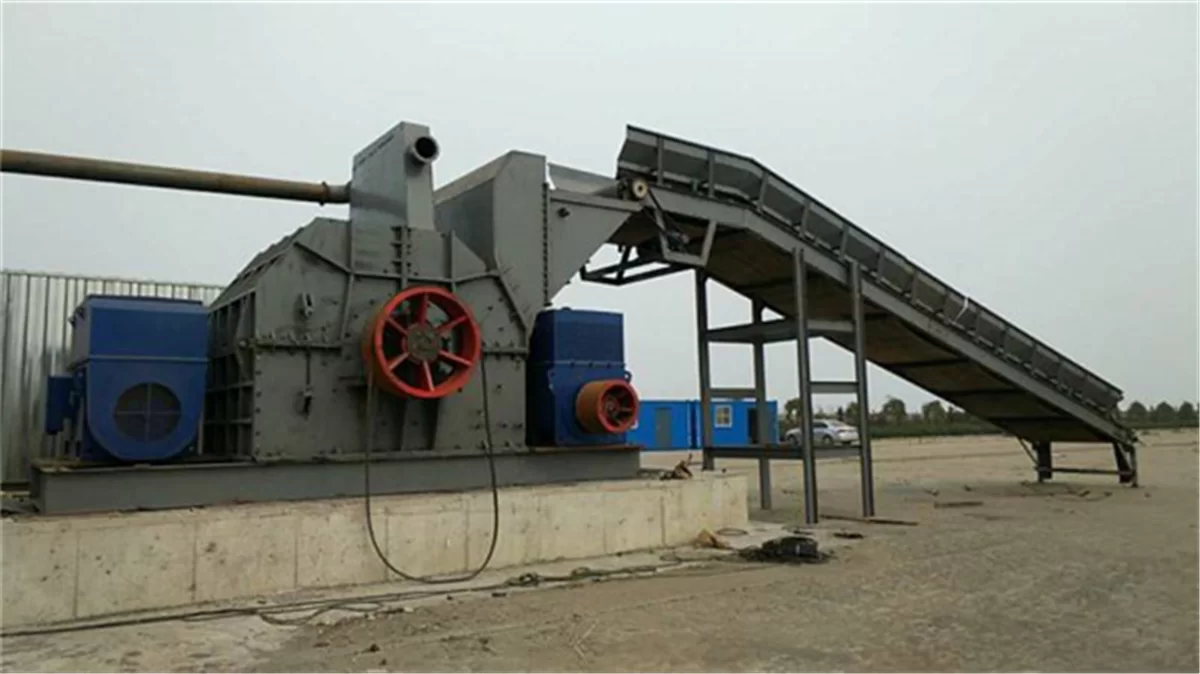
Choosing a twin shaft shredder for baled scrap involves more than matching the bale dimensions to the feed opening.
Two bales with the same outside dimensions may contain very different materials. One may consist of lightly compressed aluminum cans, while another may contain dense steel sheets, wire, folded profiles and solid metal parts. They may fit into the same hopper, but they will not place the same load on the cutter shafts.
For this reason, a baled scrap shredder should be selected according to the bale size, weight, density, material composition, metal thickness and required processing result. Motor power and nominal capacity alone are not enough to make a reliable choice.
Confirm What Is Inside the Bale
“Baled scrap” describes the physical form of the material, not its exact composition.
Common metal bales may contain:
Light-gauge steel sheets
Tinplate packaging
Aluminum cans
Aluminum sheet offcuts
Color-coated steel sheets
Appliance shells
Vehicle body sheets
Pressed production scrap
Mixed ferrous and non-ferrous metals
Plastic, rubber, fabric or other contaminants
The machine required for a clean aluminum can bale may be very different from the machine required for dense mixed steel scrap.
Before selecting a shredder, the customer should identify the normal material inside the bales rather than only sending a photo of the compressed exterior.
Photos of the loose material before baling are especially useful. They reveal whether the bale contains thin sheets, long strips, wire, hollow parts or heavy solid objects.
Match the Feed Opening to the Actual Bale Size
The feed opening must be large enough for the complete bale to enter without repeated repositioning.
Customers should provide:
Maximum bale length
Maximum bale width
Maximum bale height
Common bale dimensions
Protruding metal sections
Bale orientation during feeding
The feed opening should not be exactly the same size as the stated bale dimensions. Compressed scrap bales are rarely perfect rectangular blocks. Bent corners, binding wire and projecting metal pieces can increase the actual space required.
A suitable clearance allows the loader or feeding conveyor to place the bale into the hopper without forcing it against the sidewalls.
However, selecting an unnecessarily large shredder only because of one unusual bale can increase equipment cost, installed power and plant-space requirements. The recommended model should be based on regular production, while exceptional oversized bales can be handled separately.
Bale Weight Is as Important as Bale Dimensions
A large bale is not always heavy, and a small bale is not always easy to shred.
A 1,000 × 800 × 600 mm bale containing loosely compressed aluminum cans may weigh much less than a bale of the same dimensions containing folded steel sheets.
Bale weight affects:
Load applied to the cutter shafts
Time required to open each bale
Feeding conveyor design
Hopper and supporting-frame strength
Motor current during shredding
Number of bales processed per hour
Required crane or loader capacity
Customers should provide both the average and maximum bale weight. Using only the lightest sample can lead to an undersized machine, while using one exceptionally heavy bale may result in unnecessary oversizing.
Calculate the Approximate Bale Density
Bale density can be estimated using the bale weight and volume.
Bale density = Bale weight ÷ Bale volume
Density helps indicate how tightly the material has been compressed.
A low-density bale commonly contains more internal gaps. These gaps give the cutters more opportunities to grip the outer layers and pull the bale apart.
A high-density bale contains more material in the same space. The cutter hooks may initially contact a compact surface and require several attempts before entering between the compressed layers.
Higher density may result in:
Longer processing time per bale
Higher torque demand
More frequent automatic reversing
Greater current fluctuation
Slower feeding
Higher cutter and shaft load
Density should still be considered together with material type. A dense bale of thin aluminum cans can be easier to open than a lower-density bale containing thick steel offcuts.
Check the Maximum Metal Thickness
Average thickness does not fully describe the most difficult material the shredder will encounter.
A bale may consist mainly of thin sheet metal but include occasional thick plates, shafts, gears or structural sections. Those heavy pieces can determine the required cutter and drive configuration.
The customer should provide:
Normal material thickness
Maximum regular thickness
Maximum occasional thickness
Presence of solid parts
Maximum single-piece weight
Approximate percentage of heavy material
A twin shaft shredder intended for light baled scrap should not automatically be expected to process every solid steel object hidden inside the bale.
Large castings, thick shafts, sealed cylinders and heavy components should be removed during pre-sorting unless the proposed machine has been specifically selected for those materials.
Identify Long and Flexible Material
Long steel strips, wire, cable and reinforcing bar can behave differently from short sheet-metal pieces.
They may:
Wrap around the cutter shafts
Hold sections of the bale together
Bridge above the cutting chamber
Prevent loose output from falling
Enter the discharge conveyor unevenly
Cause frequent reversing
Customers should state the maximum length and approximate percentage of long material.
If long wire or strip is common, the supplier may need to adjust the cutter-hook design, blade arrangement and feeding process. Pre-sorting may still be the most practical option for unsuitable long pieces.
Select the Cutter Arrangement for the Processing Objective
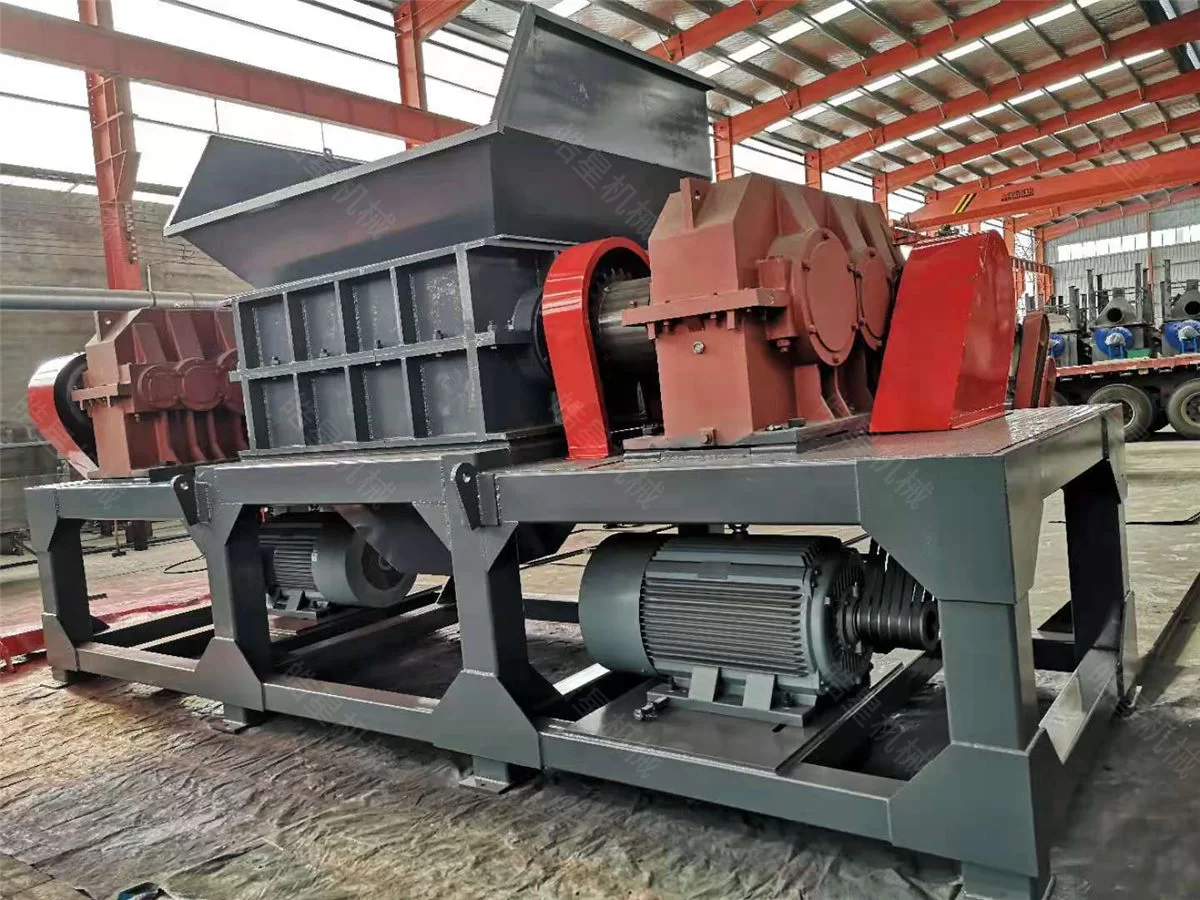
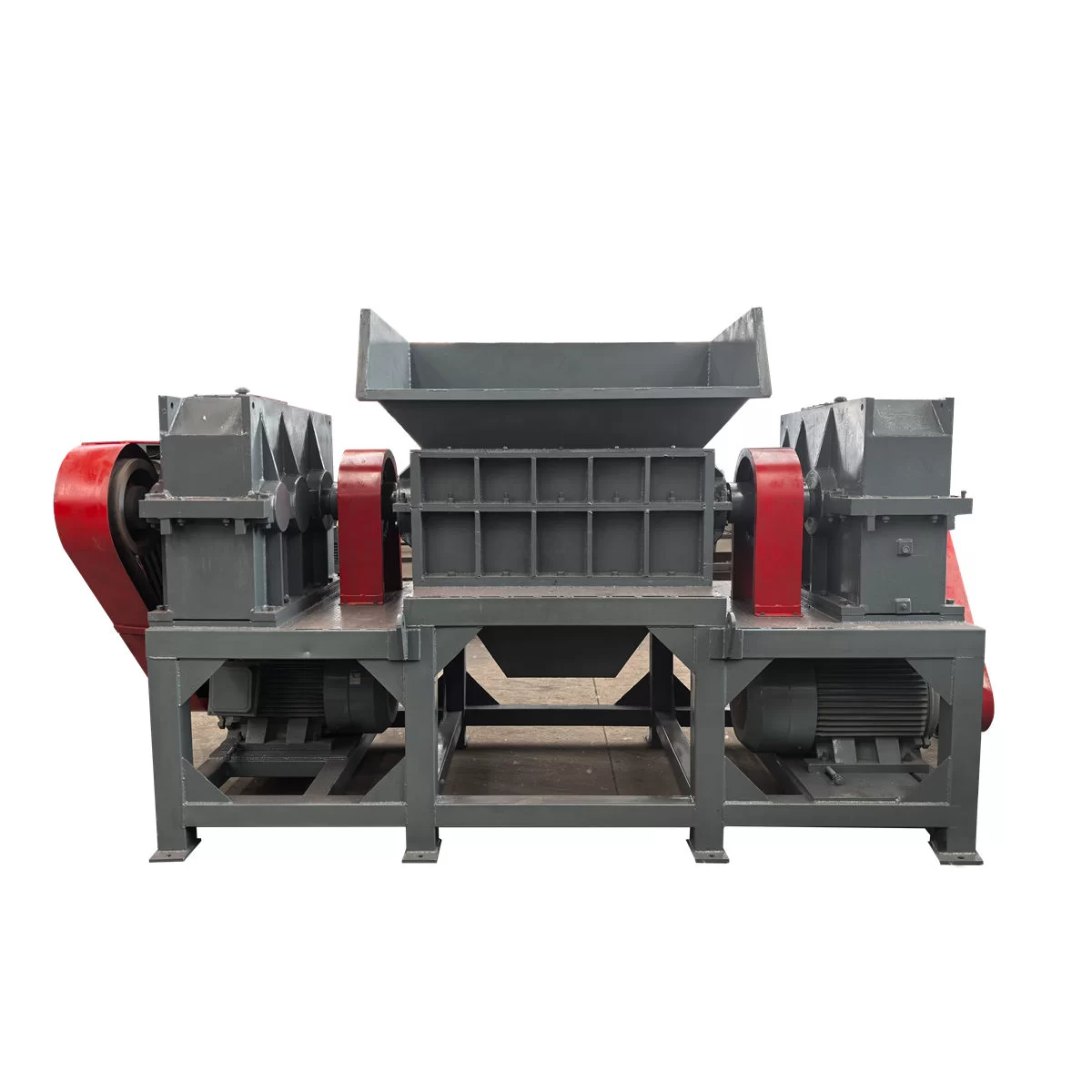
A twin shaft shredder uses intermeshing cutters to grip, tear and shear material. Cutter width, diameter, hook profile and shaft length all influence the processing result.
Wider Cutters
Wider cutters are commonly considered for stronger working conditions and coarse shredding. They provide a robust cutting structure but generally create fewer cutting positions along the shaft.
Narrower Cutters
Narrower cutters provide more cutting positions. They may increase the number of shearing actions applied to suitable material, but they are not automatically the best choice for dense or heavy scrap.
Cutter Hooks
The hook shape affects how the shredder grips the bale. A hook configuration suitable for loose sheet metal may not be ideal for a dense compressed block.
The cutter arrangement should be selected according to:
Bale density
Metal type
Material thickness
Presence of long pieces
Required processing rate
Required discharge condition
Downstream equipment
Cutter width should not be presented as an exact final particle size. Coarse shredder output normally contains irregular pieces.
Do Not Select the Machine by Motor Power Alone
Motor power is important, but it does not show the complete operating capability of a twin shaft shredder.
The actual work at the cutter shafts also depends on:
Gear reduction ratio
Shaft speed
Available torque
Cutter diameter
Blade arrangement
Cutting-chamber dimensions
Control settings
Automatic reversing logic
Two shredders with similar motor power can perform differently because of their reducers, shafts and cutting systems.
Increasing motor power also does not correct every feeding problem. If a bale cannot settle into the cutting chamber or the cutters cannot establish a stable grip, a larger motor alone will not provide consistent production.
The hopper, feeding conveyor, cutter system, shafts, reducers and electrical controls must work as one system.
Define the Required Capacity Correctly
Customers often request a machine by stating only a figure such as 3, 5 or 10 tons per hour.
The meaning of that figure must be clarified.
It could refer to:
Maximum short-term input
Nominal input under suitable conditions
Average production during one hour
Average production over a complete shift
Minimum guaranteed continuous input
Weight of the final qualified product
These are not the same.
A simple estimate can be made using:
Hourly input = Average bale weight × Bales processed per hour
If one bale weighs 500 kg and the system processes eight bales per hour, theoretical input is 4 tons per hour.
The actual average may be lower after allowing for:
Bale loading
Material positioning
Automatic reversing
Pre-sorting
Discharge delays
Inspection
Cleaning
Routine maintenance
Capacity should always be discussed under defined material and operating conditions.
Select the Feeding Method with the Shredder
The shredder cannot maintain stable output without a suitable feeding system.
Common feeding methods include:
Forklift loading
Grab crane loading
Hydraulic loader
Chain plate conveyor
Loading platform
A chain plate conveyor provides controlled feeding and can be linked to the shredder motor current. When the load rises, the conveyor stops or slows down. Feeding resumes after the load returns to the normal range.
This control is particularly useful when bale weights and densities vary.
Several dense bales should not be stacked above the cutting chamber unless the hopper and control system have been designed for that operating method.
Consider the Discharge Volume
After a bale is opened, the loose scrap can occupy several times the original compressed volume.
The discharge conveyor therefore needs enough:
Width
Sidewall height
Carrying capacity
Belt or chain strength
Speed
Transfer clearance
A conveyor selected only according to tons per hour may be too narrow for light, bulky output.
If material accumulates below the shredder, discharge from the cutting chamber becomes restricted. The entire line can lose capacity even when the shredder itself has sufficient power.
Determine Whether Secondary Crushing Is Required
A twin shaft shredder performs low-speed, high-torque coarse shredding. Its main purpose is to open compressed bales and reduce oversized material into loose, manageable pieces.
A metal crusher performs a different task. It uses high-speed hammer impact and a screen to produce smaller and more consistent output.
A metal crusher may be added when:
The coarse output is too large for the furnace
Folded sheet metal remains after bale opening
Better material liberation is required
Magnetic and eddy current separation will follow
The customer requires a controlled maximum particle size
The downstream conveyor cannot handle long pieces
If the opened material is suitable for direct furnace charging, secondary crushing may be unnecessary.
The processing objective should be confirmed before the shredder model and cutter arrangement are finalized.
Review Safety-Related Material
The customer must confirm whether the bales may contain:
Sealed containers
Gas cylinders
Fuel tanks
Batteries
Pressurized components
Oil-filled parts
Flammable material
Explosive items
Unknown hazardous waste
These materials should not be treated as ordinary baled scrap.
Pre-sorting and safe handling procedures must be established before mechanical processing.
Information Needed for Model Selection
To recommend a suitable twin shaft shredder, the customer should provide:
Clear photos of complete bales
Photos of the loose material inside
Short handling or material videos
Maximum and normal bale dimensions
Average and maximum bale weight
Approximate bale density
Main metals and their proportions
Normal and maximum material thickness
Maximum solid-piece dimensions and weight
Details of wires, cables and long strips
Required hourly capacity
Daily operating hours
Required discharge condition
Intended use after shredding
Downstream crushing or sorting requirements
Feeding method
Local voltage, frequency and phase
Available installation dimensions
Representative material testing is useful when the bale composition varies significantly.
Choose the Shredder Around the Actual Bale
A suitable baled scrap shredder is selected around the real material, not a general capacity label.
Bale dimensions determine whether the material can enter the machine. Bale weight and density affect the load and processing cycle. Metal thickness, solid objects and long pieces influence the cutter and drive configuration. The final use determines whether coarse shredding is sufficient or secondary crushing is needed.
Gongyi Haoxing Machinery Factory manufactures twin shaft shredders and complete baled scrap processing systems in China. Feeding conveyors, discharge conveyors, magnetic separators, metal crushers, screens, dust collection and electrical control systems can be configured according to the customer’s material.
Send us the bale dimensions, weight, material photos, required capacity and final use. We will review the actual working conditions and recommend a suitable configuration.
WhatsApp: +86 186 2491 0209
Website: www.hxjx08.com